Many in our country do not understand that Indian tribal sovereignty is inherent. Below we try to dispel some of the myths surrounding Tribal Government and what it means to be a sovereign nation.


Myth


Tribal Governments receive an inordinate amount of special grants from the Federal Government.

FACT

A review of Federal Grants Notices from April — July 2004 showed that Tribes are ineligible to apply for anywhere from 30% to over 50% of federal grants for which states, municipalities, nonprofits, individuals, businesses or others may apply.

Myth


Tribal governments are not really governmental entities like municipalities or states.

FACT

Tribal governments bear similar responsibilities as both municipalities and as states, yet often fulfill their obligations without the equal access to revenues from tax-bases, economic investment or revenue sharing from the federal government that municipalities or states enjoy.

Myth


Tribal governments just give 'extra' services to tribal members that they can get at other institutions.

FACT

Tribal governments often serve populations with poverty rates of 25% or more. Health and dental care at many reservations is often not easily available. Urban Indian health services are also often operating with little resources to serve high risk and often impoverished populations for diabetes, cancer, heart disease and other ailments. At Pechanga, since the advent of gaming, the rate of tribal poverty has been reduced. Our tribal members now have access to adequate health benefits.

Myth


The Pechanga Band of Luiseño Indians current form of government is a recent phenomenon.

FACT

For well over a century Pechanga tribal sovereignty and the inherent right to self-government that existed before the creation of the United States has been affirmed by the federal government. In 1882, the Executive Order of the President of the United States, restored recognition or our sovereignty over our homelands. We elect our Tribal Chair, Council and other governmental positions in elections held every two years.

Myth


Pechanga's tribal government has little in common with nonnative neighbors and rarely works within broader alliances.

FACT

Pechanga tribal government has worked successfully and with bi-partisan support of local, state and federal leaders on a variety of issues. For example, in April 2003, supporters including U.S. Senator Barbara Boxer, U.S. Representatives Mary Bono, Darrell Issa and Dale Kildee, State Senators James L. Brulte and Dennis Hollingsworth and Assembly Member Bill Leonard all took part in the successful effort of the Pechanga Band of Luiseño Indians to regain more than 700 acres of their homeland now known as the Great Oak Ranch. Tribal leaders serve on many national or regional organizations or committees addressing a variety of issues to benefit both Native and non-native peoples
While gaming is a significant revenue stream for some tribes, it is not the only source of revenue being pursued by Pechanga. The information below will share with you our focus on economic diversity and our efforts to use our revenue for the betterment of our people and the community at large.


Myth


All American Indian Tribes have gaming.

FACT

There are over 560 federally recognized Tribes in the United States and hundreds of other state recognized Tribes. Nearly half do not have gaming at all. In California, 52 Tribes have gaming out of hundreds in the state.

Myth


All Tribes with gaming are rich, and all their members are rich.

FACT

Indian gaming does help diminish the poverty rate of Native people, often by providing decent work, benefits and community infrastructure. It is not a guarantee of individual wealth.
The current national poverty rate among Native American people in the United States is high, with nearly one in four living below the poverty level, according to the 2000 US Census. 13% of tribal nations with gaming represent over 60% of annual gaming revenues nationally, while 130 tribes with gaming earned only 2% of total Indian gaming revenues.

Myth


Tribes operating Casinos are private businesses.

FACT

Tribes are not private businesses, they are governmental businesses. Sovereign Tribal governments, like private states, have the ability to allow gaming operations, such as lotteries, within their borders and to use portions of revenues generated from gaming to help provide essential services to their citizens.
Even so, there are differences. For instance, states are never mandated to share revenues with other states. Tribes, however, are often mandated via the compact process to provide portions of revenue to a state's general fund.

Myth


Tribes don't pay taxes and therefore don't contribute to the well-being of their state or surrounding area.

FACT

Tribal members do pay taxes: those who work off-reservation, or outside of direct tribal government, pay the same income, property and sales taxes that any other American citizen pays. Tribal Governments, like individual states, municipalities, and other units of government are not required to pay corporate taxes to each other. However, gaming Tribes in California are required to pay into state-controlled funds that benefit local communities, the state, and non-gaming tribes. Read more about Tribal community contributions on Economic Impact

Myth


Tribes with gaming don't provide economic benefits to non-natives, or to their neighboring communities.

FACT

Pechanga Tribal members may live on or near our Band's reservation, or may just as easily and appropriately live in surrounding urban communities, across the United States or abroad. Nationally approximately half of tribally enrolled people live on or near reservations and approximately half live off-reservation. In the case of Pechanga approximately 50% of our tribe live on or near the reservation.

bannerCultural 03

Spanish Missions and Political Intent

A 2003 report by the state of California indicates that the primary intent of Spanish Missions and forts was to expand European "ownership" of lands in North America and to protect the presumed "ownership" from encroachment by other Europeans. Spanish Period (1769-1822) "Exploration of California first occurred in 1540 when a land expedition under the command of Hernando de Alarcon traversed inland along the Colorado River. Two years later, Juan Rodriquez Cabrillo was commissioned by the Spanish government to investigate the western shores of the newly acquired territory.

In the following two centuries, little interest was given to California. By the late 18th Century, European political powers created renewed interest in California. Military "explorers" from Great Britain, France and Russia began investigating the resources along the western shores of the entire North American continent. The Spanish government, realizing that settlement by any of these foreign parties north of Mexico could become a threat, decided it was time to establish their own settlements in California.

In 1769, plans were put in place to found a series of forts (presidios) and Catholic missions along the Alta California coast extending as far north as Monterey Bay... Over the course of the next half-century, four presidios, twenty missions and three towns were established. The forts were located at San Diego, Santa Barbara, Monterey and San Francisco. The towns were founded at Los Angeles (1781), San Jose (1777) and Branciforte (1797), near Santa Cruz." — SCAG — Southern California Association of Governments, Cultural Resources DRAFT 2004 Regional Transportation Plan (RTP) Progam Environmental Impact Report (PEIR), December 2003

Page 1 of 4

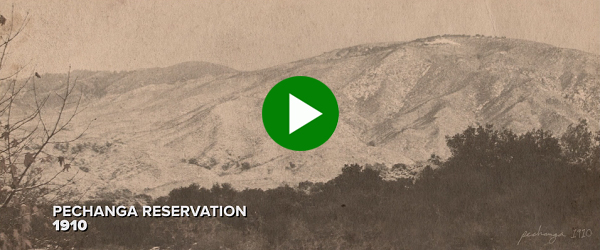
Pechanga Documentary video

Documentary1

Pu’éska Documentary video

Watch The Mountain That Weeps